
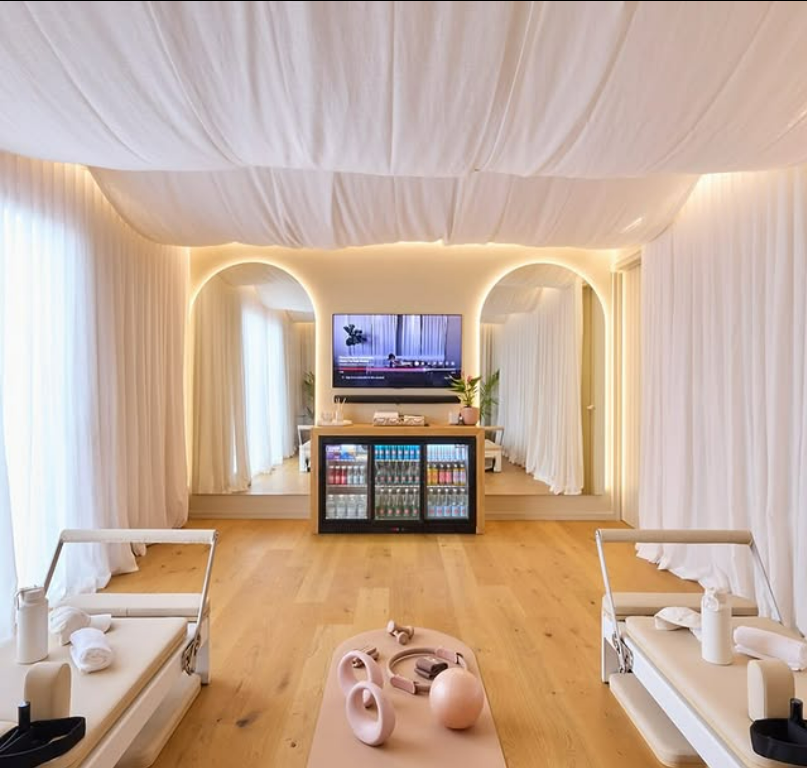
A mirror used to be an afterthought — something hung above a console table because a wall looked bare. That’s changed.
Walk through any recent renovation, and you’ll see mirrors doing real architectural work: bouncing daylight across a dim hallway, stretching a low ceiling, turning a blank stairwell wall into the room’s focal point.
At Glazify, we cut and fit these pieces for a living, so we see the difference a well-placed statement mirror makes before and after almost every week.
This guide walks through the styles worth considering, the finishing details that separate a good mirror from a forgettable one, and where to hang it so it actually earns its place on the wall.
What Makes a Mirror a Statement Mirror?
Not every large mirror is a statement piece, and not every statement mirror is large. What sets these apart is intent — the mirror is chosen to do a specific job in the room, not just fill a gap.
An architectural statement mirror usually has one or more of these qualities:
- Scale that’s deliberately generous relative to the wall, not just “big”
- Shape that breaks from the standard rectangle — arched, arabesque, portrait-cut, or fully organic
- A finish (bevelled edge, antiqued glass, integrated frame) that reads as considered rather than off-the-shelf
- Placement chosen for how it interacts with light, sightlines, or the flow of the room
A rectangular mirror from a big-box store can still look good. It just isn’t doing the same job as a piece cut and finished for the specific wall it’s going on.
Oversized Wall Mirrors: The Trend Renovation Shows Can’t Stop Talking About
If you’ve watched a renovation show in the past few years, you’ve seen the reveal moment: a single oversized mirror leaned or mounted against a wall, instantly making the room feel taller and brighter. It’s become one of the most repeated tricks in the playbook, and design editors at Houzz have documented the same effect across hundreds of real homes.
Oversized mirrors do two things well:
- They multiply light. A large mirror opposite (or perpendicular to) a window reflects daylight into the room instead of letting it stop at the glass.
- They exaggerate scale. A mirror that runs close to floor-to-ceiling height draws the eye up, which makes a standard 2.4m ceiling feel more generous than it is.
The trend has also shifted how people place them. Leaning an oversized mirror against a wall, rather than hanging it dead-centre, gives a room a slightly undone, collected-over-time look that a lot of designers are gravitating toward instead of the more formal, symmetrical hang.
One caveat worth knowing before you commit to “bigger”: oversized glass is heavy, and the fixing method matters as much as the mirror itself.
We’ve been called out to re-secure mirrors that were hung on standard picture hooks — fine for a small piece, not for 40kg of glass. If you’re going oversized, get advice on the mounting before you fall in love with a size.
Custom Shaped Mirrors: Arched, Organic and Beyond
The rectangle isn’t going anywhere, but custom-shaped mirrors are where a lot of the current interest sits.
Arched mirror designs soften a room full of hard lines — think kitchens with square cabinetry or bathrooms with rectilinear tiling. An arch at the top, straight sides, and a flat base give you a shape that reads as intentional rather than trend-chasing, and it tends to age well because arches have been a design staple for centuries.
Organic-shaped mirrors — free-form, pebble-like, asymmetric outlines — sit at the other end of the spectrum. These work best as a single hero piece rather than in pairs, and they suit interiors that already lean into curves: rounded furniture, soft plaster walls, natural materials.
A few shapes we get asked for regularly:
- Full arch (rounded top, flat bottom)
- Cathedral arch (pointed top)
- Capsule/stadium shape (rounded top and bottom)
- Organic freeform, unique to the space
- Portrait ovals for entryways and powder rooms
Because these are cut to a template rather than pulled off a shelf, the wall dimensions, the furniture beneath, and the sightline from the room’s entry point all factor into getting the proportions right.
A shape that looks perfect on a mood board can look wrong on an actual wall if the scale is off by even a few centimetres — see examples of recent shapes we’ve fitted in our project gallery.
Floor-to-Ceiling Mirrors for Maximum Light and Height
For rooms that need serious visual expansion — narrow hallways, low-ceilinged apartments, north-facing rooms that never get direct sun — a floor-to-ceiling mirror does more than an oversized one hung mid-wall.
Run correctly, it removes the visual “stop” that a framed edge creates partway up the wall. The room reads as continuing past the mirror rather than ending at it. This is particularly effective:
- Behind a stairwell or in a narrow hall, where a full-height mirror can make a corridor feel less like a tunnel
- In a dressing area, doubling as a practical full-length mirror
- Opposite a window wall, where it reflects the full window height rather than cropping it
Floor-to-ceiling installations are one of the areas where getting a custom fabricator involved pays off. Off-the-shelf panels rarely match a specific ceiling height, and a visible seam partway up defeats the purpose of going full-height in the first place.
The Finishing Details: Bevelled Edges, Custom Frames and Antiqued Glass
The shape gets the attention, but the edge finish and glass treatment are what make a mirror look custom rather than off-the-shelf. This is also where craftsmanship is easiest to spot — or easiest to see missing.
Bevelled edge mirrors have the outer few centimetres of glass ground and polished at an angle, so the edge catches and refracts light rather than sitting flat. It’s a traditional technique that reads as more expensive than a flat-polished edge, and it’s particularly effective on frameless pieces where the edge is the only detail.
Edge polishing more broadly matters even on straight-cut mirrors. A flat-polished edge (smooth, no bevel) still needs to be done properly — a rough or “arris” edge left unpolished is a sign of a rushed job and, on a statement piece, it shows.
Custom framed mirrors let the frame material do some of the design work — timber, brass, blackened steel — and they’re a good option when the mirror needs to tie into other metal or wood finishes already in the room. Frameless pieces put more weight on the shape and edge finish since there’s nothing else to look at.
Antiqued mirror glass is treated to look aged, with a mottled, slightly clouded surface rather than a perfect reflection. It’s less common than it used to be, but it remains a strong choice for period homes or anywhere a brand-new, high-clarity mirror would look out of place against original detailing.
Backlit and LED Mirrors: Statement Lighting Built In
Integrated lighting has moved from bathroom vanity mirrors into general living spaces, and it’s one of the more useful additions on this list — not just decorative.
A backlit mirror typically has LED strips set into a recessed edge or behind the glass, casting a soft halo of light around the perimeter rather than a direct beam. Used well, it does three things:
- Adds ambient light to a wall that would otherwise be flat and dark in the evening
- Creates a genuine focal point without needing a separate light fitting
- In bathrooms, gives shadow-free light for grooming — the original reason these took off
The main thing to get right is colour temperature. Warm white (around 2700–3000K on the standard Kelvin colour scale) suits most living spaces; a cooler, more neutral white (4000K+) works better for bathroom vanity use where accurate colour and grooming visibility matter more than mood. Browse our LED and backlit mirror range for finish and temperature options.
Robe Mirror Doors: A Space-Saving Statement
Not every statement mirror needs its own wall. Mirrored robe doors are the quiet workhorse of this category — you get the light-bouncing, room-expanding benefit of a large mirror without giving up any floor space, because the mirror is doing double duty as a functioning wardrobe door.
They’re particularly worth considering in:
- Bedrooms where a freestanding full-length mirror would compete for limited floor space
- Apartments and smaller homes where every wall is already earmarked for furniture
- Hallway-adjacent robes, where the reflected light spills into the connecting space
The trade-off is that robe mirrors are functional first, decorative second — hardware, door alignment, and glass weight on the track all need to be right, which is a different fabrication and fitting job than hanging a fixed wall mirror.
Mirror Placement for Natural Light: Where It Actually Works
Placement decides whether a mirror amplifies a room or just reflects a wall you don’t want to look at twice. A few placement principles we come back to on almost every project:
- Opposite a window, not beside it. Directly opposite reflects the most usable daylight back into the room. Perpendicular placement works too, but reflects less light overall.
- Avoid facing another mirror. Two mirrors facing each other create a repeating “infinity” reflection that reads as disorienting rather than expansive in a lived-in room.
- Consider what’s being reflected, not just the light. A mirror that beautifully doubles the light but reflects the inside of a cluttered cupboard or a bathroom door isn’t doing its job. Stand where the mirror will hang and look at what’s actually behind you before committing to the wall.
- Hang at eye level for functional pieces, higher for pure statement. A hallway or entry mirror people will actually check themselves in needs a practical hanging height; a stairwell or high-wall statement piece can sit higher since it’s read from a distance.
Our Process at Glazify: From Concept to Installed Statement Mirror
Custom mirror work is glass fabrication, not off-the-shelf retail, so the process looks different from buying a mirror in a shop:
- Site measure. We measure the actual wall, not just the space you think you have — out-of-square walls and skirting boards change the real cut dimensions more often than people expect.
- Shape and finish confirmation. For anything beyond a standard rectangle, we template the shape and confirm edge finish (bevelled, flat-polished, framed) before cutting.
- Cutting and edgework. Glass is cut to the confirmed template, then edges are ground and polished in-house.
- Backing and safety treatment. Depending on placement, mirrors are backed and, where required near doors, stairs or high-traffic zones, specified as safety glass in line with AS 1288, the Australian Standard for glass in buildings.
- Installation. Fixed with hardware rated for the mirror’s actual weight — critical for anything approaching floor-to-ceiling scale.
We stand behind the fabrication and the fit. If an edge, a fixing, or a finish isn’t right, we come back and correct it — that’s a straightforward part of doing custom glass work properly, not an exception. Read more about our team and approach on the About Glazify page.
Frequently Asked Questions About Statement Mirrors
What makes a mirror a statement mirror?
A statement mirror is chosen for the specific effect it creates in a room — through scale, shape, or finish — rather than just filling wall space. Oversized dimensions, a custom shape like an arch or organic outline, or a distinctive edge and frame are what usually separate a statement piece from a standard mirror.
Can a large mirror make a small room look bigger?
Yes. A large mirror reflects both light and the far side of the room, which reads visually as extra depth. It works best placed opposite a window or a room’s main light source, and least well in a spot that only reflects a wall or a cluttered corner.
Where is the best place to put a statement mirror?
Opposite or perpendicular to a natural light source is the strongest placement for brightening a room. Beyond light, consider sightlines from the room’s entry point and what the mirror will actually reflect — a beautiful mirror facing a bad view of the room undercuts its own impact.
Are custom-shaped mirrors suitable for modern interiors?
Yes, particularly arched and softly curved shapes, which are widely used to offset the hard lines of contemporary cabinetry, tiling, and joinery. Fully organic, asymmetric shapes work best as a single feature piece rather than repeated throughout a modern space.
Should a statement mirror be framed or frameless?
It depends on the wall it’s going on. A frame lets the mirror tie into existing metal or timber tones in the room and suits more traditional or eclectic interiors. Frameless mirrors put the focus on the shape and edge finish — bevelled or flat-polished — and tend to suit minimal, contemporary spaces.
Ready to Design Your Statement Mirror?
A statement mirror is one of the few renovation choices that changes how a room feels without changing a single wall.
The right shape, edge finish, and placement can make a room brighter, taller, and more considered — and getting those details wrong is exactly why this isn’t an off-the-shelf purchase for anything beyond a standard rectangle.
Glazify designs and fabricates custom mirrors — oversized, arched, backlit, antiqued, or built into robe doors — measured and cut for your actual space, not a standard size.
Get in touch with our team for a measurement and quote, and we’ll talk through what shape, finish, and placement will work best for your room.